What is a booking fee, who actually keeps that money, and why the band almost never sees a penny of it. A plain look at the line on your ticket.
You see a ticket advertised at 25. You get to the checkout screen and it says 31.40. Somewhere between those two numbers a booking fee happened, and nobody in the chain seems keen to explain it.
So let's do the explaining. What is a booking fee, who actually keeps the money, and does any of it ever reach the band playing the show? That last answer is the one that surprises people.
What is a booking fee, exactly
A booking fee is a charge added by whoever sells you the ticket, on top of the face value that the promoter and the artist agreed on. Face value is the number on the poster. The booking fee is everything bolted on after it.
It rarely arrives alone. You might see a service charge, a facility fee, an order processing fee and a delivery fee on the same purchase. Some are charged per ticket, some per order, which is why buying four at once often costs less in fees than buying them one at a time.
As a rough guide, fees typically add somewhere between about 10 and 30 percent of face value, and they bite hardest on cheap tickets because the flat components do not shrink.
Who charges it and who keeps it
This is where the story gets more interesting than the maths.
- •Service charge usually goes to the ticketing platform, but a slice is often rebated back to the venue or promoter. That rebate is frequently the reason a venue signed an exclusive ticketing deal in the first place.
- •Facility fee goes to the building. It funds the things nobody sells tickets for: security, cleaning, insurance, the roof.
- •Order processing fee covers the per-transaction stuff, including card fees and customer service.
- •Delivery fee covers posting or, brilliantly, emailing you a PDF.
The important bit: the fee is not one company being greedy. It is a small pile of separate arrangements between a platform, a venue and a promoter, presented to you as one number at checkout.
Why booking fees exist at all
Partly because they cover real costs. On-sale traffic spikes, fraud screening, refunds and customer support are not free.
But the honest reason they sit outside face value is marketing. A show advertised at 25 sells better than the same show advertised at 31, even when 31 is what everyone ends up paying. Fees let the advertised number stay low, and the pressure to keep that number low comes from the whole industry, not just the ticketing companies.
That is also why all-in pricing, where the advertised price already includes the fees, keeps coming up as a fix. It is fairer and less annoying. It also makes your show look more expensive than the one down the road that has not adopted it yet, which is exactly why adoption is slow.
Does the band see any of the booking fee?
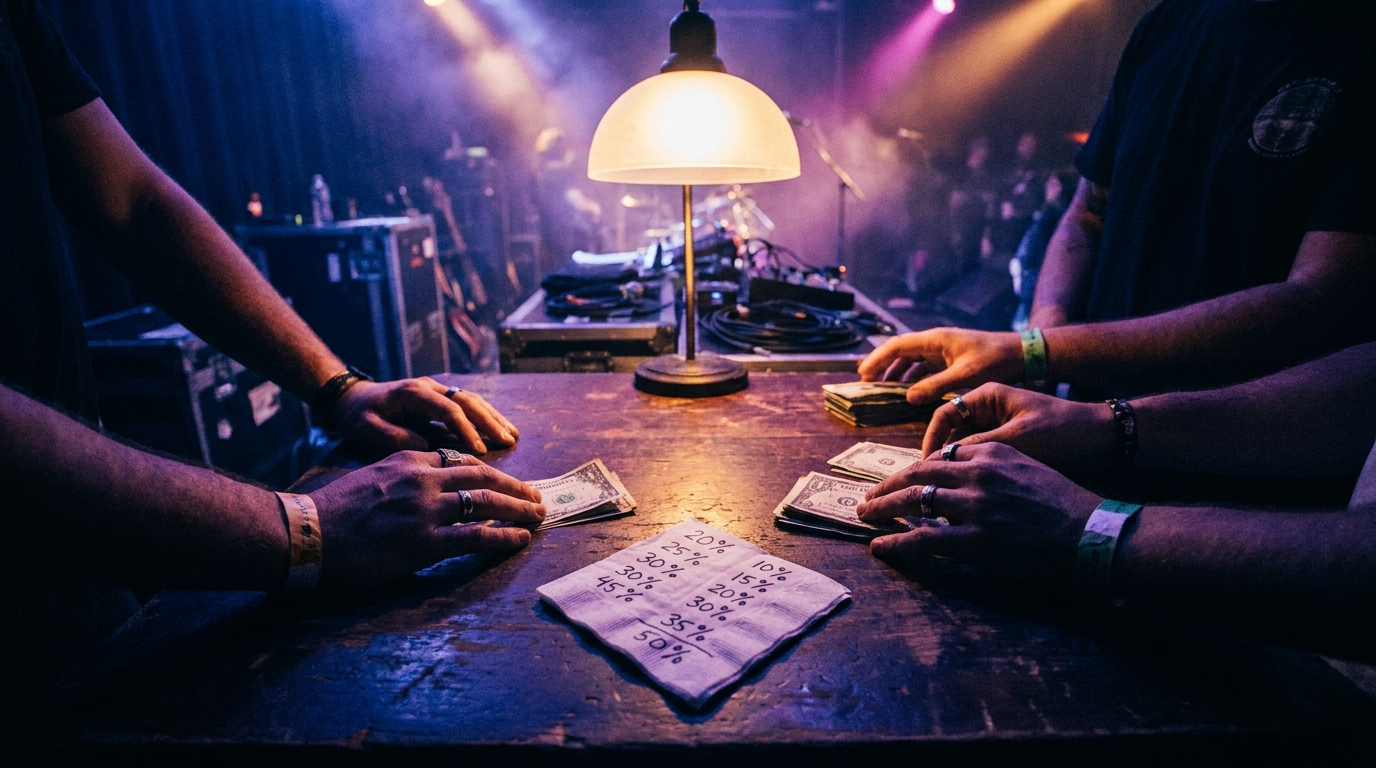
Almost never. A band is usually paid a guarantee, a percentage of the door, or whichever is higher, and those percentages are calculated on face value, often after sales tax and sometimes after other deductions too. The fees sit outside that pot.
So when a fan tells you the ticket cost 31 and you got paid on a 25 ticket, you are both telling the truth. Worth knowing before you take that conversation personally at the merch table.
What it means when you are setting your own ticket price
Price for what the fan actually pays, not for what you print. If your gig is 12 and fees add 3, your audience is deciding whether to spend 15, plus travel, plus a drink. That is the real decision on their side of the screen.
A few things worth doing:
- •Ask the promoter what fees will be added before you agree on face value. Ask for the all-in number.
- •Find out whether the venue has an exclusive ticketing deal. If it does, the fee is not negotiable and you should stop trying.
- •If you self-sell to your own list, keep the fee tiny and say so. Fans notice.
- •Remember the merch table takes cash with no fee attached. It is often the most profitable metre of the building.
Practising the maths without losing real money
Ticket pricing is much cheaper to learn in a game than on a Tuesday night in a half-empty room. In Road to Headliner you book your own shows into venues with real capacities and cuts, in front of an audience that reacts to what you charge. Price too high in a city that does not know you yet and you watch the room stay empty. The shows and touring guide covers how venue cuts and pricing interact.
If you want the layer above this, our breakdown of how concert promotion works explains where the promoter's risk sits, and how to book your first shows covers the part where you have to send the email.
Booking fees are not going away, and understanding them will not make your ticket cheaper. But it will stop you blaming the wrong person, and it will make you a much better negotiator the first time a promoter asks what you want on the door.
Fancy running a band where you set the price and live with it? Road to Headliner is free, runs in your browser, and you can have your first gig booked in about five minutes.