How Concert Promotion Works: Venues, Guarantees and the Door Split
How concert promotion works, in plain English: promoters, guarantees, the door split and who really takes the risk when your band plays a show.
Walk past a sold-out club and you will see the band's name on the marquee. You will not see the promoter, and they are the reason the show happened at all.
That is the strange thing about live music. The person who takes the biggest financial gamble on the night is usually invisible to the crowd. So let's pull back the curtain on how concert promotion works, who actually pays for what, and why the deal behind the gig matters as much as the gig itself.
How concert promotion works, starting with the promoter
A promoter is the person who bets money that people will show up.
They book the venue, agree a fee with the band, pay for the posters and the local ads, and hope ticket sales cover all of it plus a margin. If the room is packed, they do well. If it rains and forty people turn up, that loss is theirs, not the band's.
Sometimes the promoter is a big national company. Sometimes it is one stubborn person who loves a scene and runs shows out of a back room. The job is the same at every level: take the risk so the music can happen.
Guarantees, the door, and the split
There are roughly three ways a band gets paid, and it is worth knowing all three.
- •A guarantee is a flat fee. You play, you get that amount, sold out or empty. Safe for the band, risky for the promoter.
- •A door deal pays the band a cut of ticket sales, often after the venue takes its costs off the top. Big upside on a good night, nothing much on a bad one.
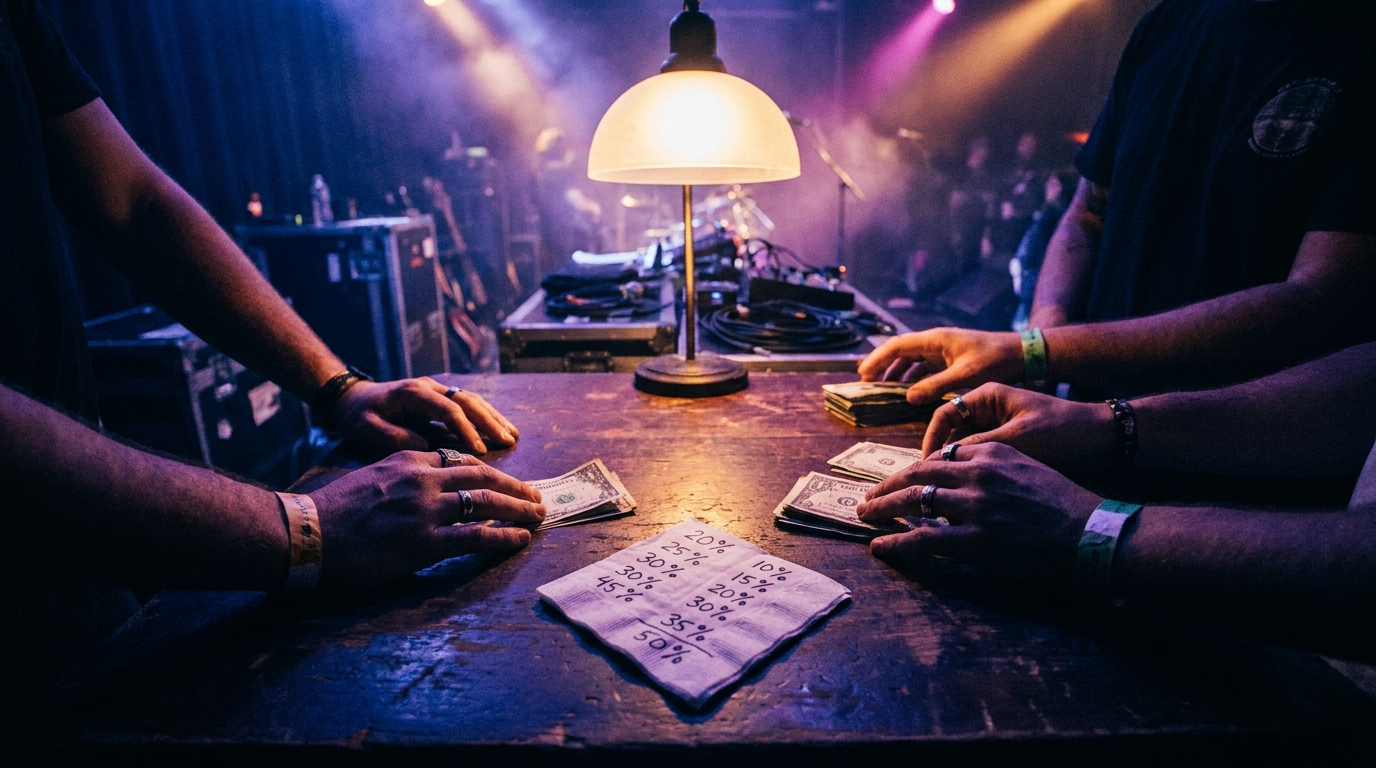
- •A split, usually written as something like 'guarantee versus 70 percent of the door, whichever is greater'. You get the safety of a floor and the upside if the night goes off.
New bands take guarantees because they cannot afford a quiet night. Established acts that reliably sell tickets push for the door deal, because they know the room is going to fill and they want their share of it.
How venues price a show
A venue is doing quiet maths the whole time.
Capacity times ticket price is the ceiling on the night. From that, the promoter subtracts the band fee, staff, security, sound, and the rent on the room. Whatever is left is the margin, and it is usually thinner than people imagine.
This is why support slots exist. The opening band fills early seats and gets the bar selling, often for a small fee or just the exposure. It is a real rung on the ladder, even when the cheque is tiny.
Risk is the whole game
Strip everything else away and concert promotion is a bet on a crowd.
The promoter who guesses right about demand makes money. The one who overpays a band that cannot sell, or books a 1,000-cap room for a 300-cap act, eats the loss. Touring sits on top of all this, and we get into why the road is so brutal in the economics of touring.
If you want to see the booking side from the band's chair, the first shows guide walks through finding venues and not embarrassing yourself on a Tuesday.
How it feels in the game
This is exactly the tension we wanted to make playable. In Road to Headliner, booking a show means weighing the room size against the crowd you can actually pull, and a half-empty venue costs you money and reputation.
Push too big too soon and you learn the promoter's lesson the hard way. The shows and touring guide lays out how venues, draw and payouts connect once you are in.
Concert promotion is risk management dressed up as a party. Learn to read the room, literally, and the gigs start paying for themselves. The best way to feel it is to book a few of your own, so start a band free and put a show on sale tonight.